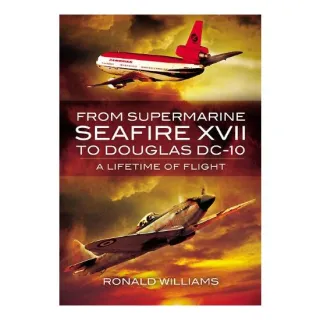
From Supermarine Seafire Xvii To Douglas Dc10
🛈 Nu vindem cărți — comparăm prețuri. Comanda o plasezi direct pe site-ul librăriei.
„From Supermarine Seafire Xvii To Douglas Dc10” se găsește acum în 1 ofertă disponibilă, la 37,99 RON. Cel mai mic preț este 37,99 RON la Anticariat Ex Libris. Verifică toate ofertele mai jos și comandă direct de la librăria aleasă.
Compară prețuri în 1 ofertă
Prețurile se actualizează zilnic. Ultima verificare a ofertei principale: 20.09.2026. Confirmă prețul final și livrarea pe site-ul librăriei.
Despre carte
Ron Williams'' flying career started in the Royal Naval Volunteer Reserve which he joined for his National Service in the 1950s. Having completed this he became a civilian pilot and embarked on a career that would see him flying an amazing variety of aircraft in all parts of the world. His first operational naval aircraft was the Seafire XVII, a direct descendent of the Spitfire. This aircraft was capable of 480 knots, and it was during his first solo flight in one that he very nearly killed himself trying to achieve that speed. Luckily he escaped unharmed but much chastened. Whilst serving with the RNVR he also went solo on the Hawker Sea Fury, the world''s fastest piston engine at that time, and also the jet powered Attacker. Having obtained his civilian pilot''s licence he commenced flying DC-3s for Cambrian Airways around the UK and Europe. He then moved to a charter airline, Independent Air Travel flying the Vickers Viking, then to BlueAir flying DC-4s to Hong Kong and the Far-East. Next came Airwork based in Adelaide, still on DC-4s. A return to the UK saw him flying the Bristol Freighter from Southend Airport to the near Continent carrying passengers and their cars. Tragedy nearly struck when he was attempting to deliver a Scottish Aviation Twin Pioneer from Southend to the Cape Verde Islands. One of the legs of this flight entailed a stop-over on Fuerteventura, one of the Canary Islands. Having elected to fly at night the small twin-engined aircraft hit bad weather and became lost. Unable to make radio contact and running out of fuel he was forced to ditch into the Atlantic in the eye of a hurricane. A Spanish fishing boat was fortunately to hand and rescued Ron, his co-pilot and single passenger. A move to Eire and Air Lingus followed, captaining Boeing 707s to...
Evoluția prețului
Cărți similare
 Scandalous Liaisons
de la 21,99 RON în 2 librării
Scandalous Liaisons
de la 21,99 RON în 2 librării
 Adolf Hitler
de la 8,99 RON în 2 librării
Adolf Hitler
de la 8,99 RON în 2 librării
 Robin Hood
de la 15,07 RON în 2 librării
Robin Hood
de la 15,07 RON în 2 librării
 Hyde Park
de la 8,99 RON în 2 librării
Hyde Park
de la 8,99 RON în 2 librării
 Unfortunate Colonel Despard
de la 6,99 RON
Unfortunate Colonel Despard
de la 6,99 RON
 End of the Age
de la 18,98 RON
End of the Age
de la 18,98 RON
 Dole Queues and Demons
de la 8,99 RON
Dole Queues and Demons
de la 8,99 RON
 Annual Of German & European Law
de la 8,99 RON
Annual Of German & European Law
de la 8,99 RON